Wine basics
How to Read a Wine Label: Old World vs. New World Explained
Wine labels look like puzzles until you know the regional rules. Once you understand what each country puts on the label — and what it leaves off — choosing wine gets dramatically easier.
Key takeaways
- New World labels lead with grape; Old World labels lead with place.
- Vintage year matters most for age-worthy wines; less for everyday bottles.
- Alcohol percentage hints at body — higher often means riper, fuller wine.
Universal elements
What every label tries to tell you
Nearly every wine label answers four questions: who made it, where it comes from, what year it was harvested, and how strong it is. Producer name is usually the largest text. Geographic origin ranges from a broad country ("Product of Italy") to a specific vineyard. Vintage is the harvest year — not the bottling date. Alcohol by volume (ABV) typically runs 11.5–15% for table wine.
Volume and containership details matter for shopping: standard bottles are 750 ml. Half-bottles (375 ml) and magnums (1.5 L) sometimes indicate a different aging profile or release strategy. Sulfite declarations ("Contains sulfites") are legal requirements, not quality indicators.
Sustainability and certification marks — organic, biodynamic, vegan — appear increasingly on front and back labels. These describe farming and winemaking practices, not flavor.
New World
Labels that lead with grape variety
United States, Australia, New Zealand, Chile, Argentina, and South Africa typically print grape variety prominently: Cabernet Sauvignon, Chardonnay, Pinot Noir. If the label says "Merlot" and nothing else about blend, U.S. law requires at least 75% Merlot in the bottle.
AVA (American Viticultural Area) names — Napa Valley, Willamette Valley, Barossa Valley — indicate origin but allow blending across sub-regions. A "California" designation is broader still. More specific geography usually signals more focused terroir expression.
New World labels tend to be marketing-forward: proprietary names ("The Prisoner"), animal icons, and vintage prominently displayed. This makes them easier for beginners but can obscure the producer behind a brand.
Old World
Labels that lead with place
France, Italy, Spain, Portugal, and Germany prioritize origin over grape. A red wine labeled "Chianti Classico DOCG" is Sangiovese-dominant by law — but the label may never say "Sangiovese." Burgundy labels show village or vineyard; knowing that red Burgundy is Pinot Noir and white Burgundy is Chardonnay is essential background.
Classification tiers encode quality hierarchy. Bordeaux châteaux carry cru classé rankings. Burgundy distinguishes village, premier cru, and grand cru. Italian labels add Riserva (extra aging) and Classico (historic core zone). These terms predict price and style more reliably than front-label artwork.
German labels include sweetness indicators — Kabinett, Spätlese, Auslese — that matter as much as grape. A "Riesling Spätlese" tells you both variety and ripeness level at harvest.
Speed shortcut
When reading is not fast enough
Label literacy is a skill that builds over years. In the moment — at a wine shop shelf, over a restaurant list, during a tasting — you may not have time to decode an unfamiliar appellation.
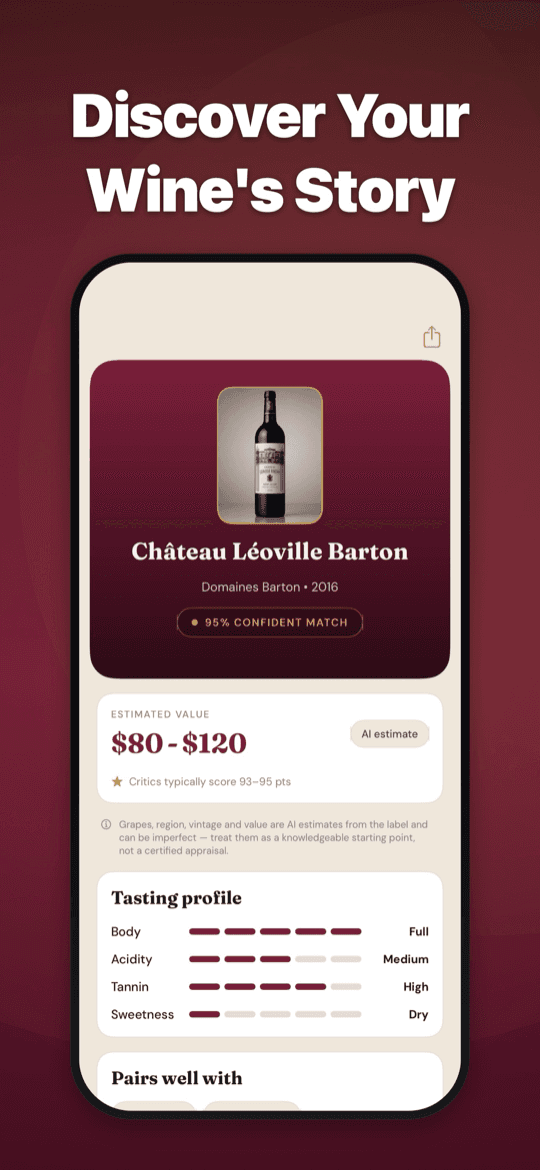
Wine Identifier bridges the gap: photograph the label and receive a plain-language breakdown of producer, region, likely grapes, tasting structure, and serving guidance. It is the difference between recognizing "Pauillac" on a label and knowing whether that Bordeaux will feel cedary and tannic or approachable tonight.
Use manual label reading to build long-term knowledge. Use scanning when the decision is happening now.
Try it yourself
Scan any label. Get the full dossier.
Wine Identifier is free to download with one complete scan per day. Pro unlocks unlimited scans, the full Wine Library, and cellar value insights — built for shops, restaurants, and home cellars.
FAQ
Common questions
What does "Reserve" or "Reserva" mean on a label?+
It depends on the country. In Spain, Reserva and Gran Reserva legally require minimum aging. In the U.S., "Reserve" has no legal definition — it is a marketing term unless tied to a regulated appellation elsewhere.
Why do some labels not show the grape variety?+
Old World wine laws define wines by place, not grape. The appellation rules specify permitted varieties. Burgundy, Rioja, and Chianti labels assume you know — or will learn — what grows there.
Does a higher price on the label mean better wine?+
Price reflects production cost, scarcity, brand prestige, and import tariffs — not guaranteed quality in your glass. A well-chosen $20 bottle often outperforms a mediocre $60 label on a given night.
Can I scan a label instead of learning all this?+
Yes. Scanning gives instant context while you build label literacy over time. Wine Identifier returns grape, region, and style notes in plain language so you learn with every bottle.