Wine basics
How to Tell If Wine Is Bad: 5 Signs + Open-Bottle Chart
You opened this bottle sometime last week, it has been sitting in the fridge door, and now you want one honest answer before you pour: is it still good? Here is how to check in under a minute — and how long each type of wine actually keeps once the cork comes out.
Key takeaways
- Smell first: vinegar, wet cardboard, or stewed fruit means the bottle is gone.
- Most opened bottles hold 3-5 days recorked in the fridge — reds included.
- Spoiled wine tastes bad but is not dangerous; corked wine is a fault you can return.
Answer first
How can you tell if wine is bad?
Smell it. A wine that has gone bad almost always announces itself in the glass before you taste it: sharp vinegar or nail-polish fumes, a wet-cardboard or damp-basement mustiness, or a cooked, stewed-fruit sweetness that flattens everything else. If the aroma is clean and fruity, the wine is fine — regardless of what the date on the bottle says.
Then look at the color. White wine that has drifted from pale straw to deep gold or brown has oxidized. A young red that has gone brick-orange at the rim has done the same. Bubbles rising in a wine that is supposed to be still mean it has refermented in the bottle, and that wine is finished.
Finally, taste a small sip. Bad wine tastes flat, sour, or dull — the fruit has dropped out and what remains is acid and alcohol. If the first three checks pass and the sip tastes like wine, it is good to drink. The whole test takes about thirty seconds.
| Sign | What you notice | Cause |
|---|---|---|
| Vinegar or nail polish | Sharp, stinging smell; makes your eyes water | Acetic acid and ethyl acetate from air exposure |
| Wet cardboard or damp basement | Muted fruit, musty note that grows in the glass | Cork taint (TCA) — the bottle is "corked" |
| Stewed or raisiny fruit | Tastes cooked and flat, like jam left on the stove | Heat damage in shipping or storage |
| Brown or dull color | White turned deep gold; young red brick at the rim | Oxidation |
| Bubbles in a still wine | Fine fizz on the tongue, slight yeasty smell | Unintended refermentation |
Open bottles
How long does wine last after opening?
Three to five days for most bottles, recorked and kept in the fridge. That includes red wine — the fridge slows oxidation, and you can let the glass warm up for fifteen minutes before drinking. The number moves with the style: the more delicate the wine, the faster it fades, and sparkling wine is the fastest of all because it loses its bubbles as well as its fruit.
The clock is driven by oxygen, so the practical rule is to reduce the air in the bottle and the temperature around it. Recork it tightly (a screwcap is even better), stand it upright to shrink the surface exposed to air, and put it in the main body of the fridge rather than the door, where temperature swings every time someone opens it.
Half-empty bottles fade faster than nearly full ones, which is why decanting the leftovers into a smaller bottle buys you an extra day or two. Vacuum stoppers help modestly; inert-gas sprays help more. Neither one turns a three-day wine into a three-week wine.
| Wine type | Keeps for | Notes |
|---|---|---|
| Sparkling (Champagne, Prosecco) | 1-3 days | Only with a proper sparkling stopper; bubbles go first |
| Light white and rosé | 3-5 days | Sauvignon Blanc, Pinot Grigio, dry rosé |
| Full-bodied white | 3-5 days | Oaked Chardonnay, Viognier — often better on day two |
| Light red | 2-3 days | Pinot Noir, Gamay, Beaujolais — the most fragile reds |
| Full-bodied red | 3-5 days | Cabernet, Syrah, Bordeaux blends; refrigerate them too |
| Fortified (Port, Sherry, Madeira) | 1-4 weeks | Tawny Port and Madeira are the most forgiving wines you own |
| Boxed wine | 3-4 weeks | The bag collapses as you pour, so almost no air gets in |
The two-week question
Can you drink wine that has been open for 2 weeks?
You can drink it safely, but you probably will not enjoy it. After two weeks in the fridge a normal table wine has lost most of its aromatic fruit and tastes flat and sour — closer to cooking wine than to what you opened. The exceptions are the fortified bottles: Port, Sherry, Madeira, and vermouth are made in a way that shrugs off weeks of air.
The same answer scales down. At four days most bottles are still good. At one week a sturdy red is tired but drinkable, and a delicate white is usually done. At a month, only fortified wine and boxed wine are still worth pouring into a glass.
Wine that is past its prime for drinking is often still perfect for cooking. Oxidized red goes into a braise or a pan sauce; oxidized white deglazes a pan without anyone noticing. The one wine you should not cook with is a corked bottle — the musty TCA note survives heat and will spread through the dish.
Cork taint
What does corked wine taste like?
Corked wine smells like a wet newspaper, a damp basement, or a mouldy cloth, and it tastes muted rather than sour. The compound responsible is TCA, formed in natural cork, and its effect is subtractive: it strips the fruit out of the wine and leaves a hollow, musty shell. In mild cases the wine simply seems boring, which is why cork taint often gets blamed on the winemaker instead.
It affects only a small share of cork-sealed bottles — around one in a hundred today, down from far higher rates a couple of decades ago — and it has nothing to do with how you stored the wine or how long it was open. A screwcapped bottle cannot be corked at all. Bits of cork floating in your glass are also not cork taint; they are just a broken cork, and you can fish them out.
Corked wine is a fault, not spoilage, and most reputable shops and restaurants will replace or refund the bottle if you bring it back with the cork. Keep the cork, keep the remaining wine, and say the bottle was corked — it is a normal, expected part of selling wine and nobody will argue with you.
Sealed bottles
Does unopened wine go bad?
Yes, but slowly, and almost no wine carries a real expiration date. The printed year on a bottle is the vintage — the year the grapes were picked — not a use-by date. Most everyday white and rosé is at its best within one to two years of that vintage; most everyday red within two to three; sparkling wine within three to four. Only a small fraction of wine is built to improve for a decade or more.
Storage decides more than age. Sustained heat is the fastest way to ruin a sealed bottle, and a car parked in the sun makes an efficient oven — the wine expands, pushes the cork up past the capsule, and comes out tasting stewed. Sticky seepage around the capsule or a cork sitting proud of the bottle lip is a reliable sign of heat damage before you ever open it. Store bottles on their side, somewhere dark and cool, away from vibration.
That old bottle at the back of the cupboard is worth opening rather than agonizing over. If it was a supermarket red from six years ago it has almost certainly faded, but it is not dangerous — pour a small glass and use the smell test. Sediment at the bottom of an older red, or the tiny tartrate crystals that look like glass shards on the cork, are both harmless and normal.
Safety
Is it safe to drink wine that has gone bad?
In almost every case, yes. Wine's alcohol, acidity, and low pH make it a hostile place for the organisms that cause food poisoning, and the microbes that do spoil wine — acetic acid bacteria, Brettanomyces yeast — are not pathogens. Oxidized, vinegary, or corked wine is a quality problem, not a safety one. The realistic worst case for drinking a glass of badly oxidized wine is a headache or mild stomach upset.
Two situations do deserve a hard stop: visible mould floating on the surface of the wine, and any bottle that has been opened, left at room temperature, and then topped up or mixed with something else. Neither is common, and both are obvious when you look.
None of this is medical advice, and it does not extend past the wine itself. If a bottle smells clean, it is fine. If it smells like vinegar, the only thing you lose by pouring it out is the wine.
Before you open it
How do you check a bottle before you pull the cork?
The smell test only works after the bottle is open, which is the wrong order when the wine is a gift, an old bottle you inherited, or something you are deciding whether to save for a better occasion. What you want first is context: what the wine is, roughly how long that style is meant to keep, and whether the vintage in front of you is early, in the window, or past it.
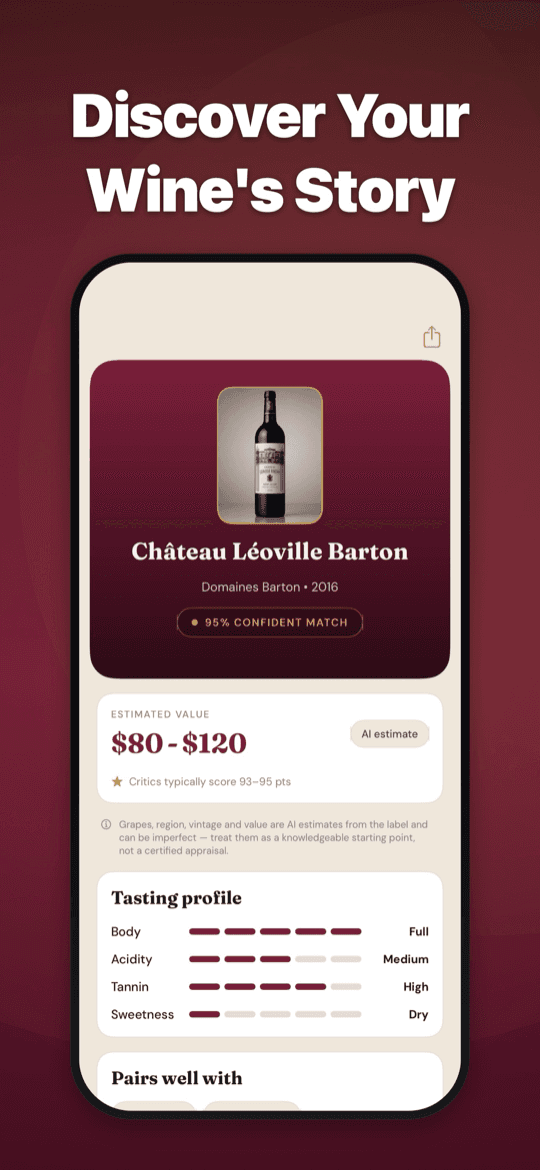
That is what a label scan gives you. Wine Identifier reads the front label and returns the producer, region, grape, vintage, tasting profile, serving temperature, and a drinking-window estimate — so a bottle you know nothing about becomes a decision in about ten seconds. Bottles you keep can go into a cellar list that flags the ones approaching the end of their window instead of letting them quietly slip past it.
A drinking window is a style-based estimate, not a guarantee about your specific bottle: it cannot know that this one spent a summer in a hot car. Use it to decide what to open first, and keep using your nose on the wine actually in the glass. If the wine turns out to be worth chilling properly, the serving temperature guide covers what to do next.
Try it yourself
Scan any label. Get the full dossier.
Wine Identifier is free to download with one complete scan per day. Pro unlocks unlimited scans, the full Wine Library, and cellar value insights — built for shops, restaurants, and home cellars.
FAQ
Common questions
How long does an opened bottle of red wine last?+
Three to five days for a full-bodied red like Cabernet or Syrah, and two to three days for a light red like Pinot Noir, provided it is recorked and kept in the fridge. Refrigerating red wine after opening slows oxidation; let the glass warm up for about fifteen minutes before drinking.
Can you drink wine that has been open for a month?+
It is safe to drink but will taste flat and sour, because a month of air exposure strips out the fruit. Fortified wines such as Port, Sherry, and Madeira, and boxed wine in a collapsing bag, are the exceptions and can still be good after several weeks.
Does wine expire if it is unopened?+
Wine does not carry an expiration date, but it does have a drinking window. Most everyday whites are best within one to two years of the vintage and everyday reds within two to three; only age-worthy wines improve for a decade or more. Heat and light shorten every one of those windows.
What does bad wine taste like?+
Spoiled wine tastes sour and flat, like sharp vinegar or like fruit that has been cooked. Corked wine is different: it tastes muted and musty, as if the flavour has been drained out, with a wet-cardboard smell.
Is it safe to drink wine that has gone bad?+
Generally yes. Wine's alcohol and acidity prevent the growth of food-poisoning organisms, and the microbes that spoil wine are not pathogens, so bad wine is unpleasant rather than dangerous. Discard any bottle with visible mould on the surface of the wine.
How can I tell if a wine was damaged by heat?+
Look at the cork and the capsule before opening: a cork pushed up above the bottle lip or sticky seepage around the capsule means the wine expanded from heat. In the glass, heat-damaged wine tastes stewed or raisiny and has a dull, browned colour.
Can you cook with wine that has been open for two weeks?+
Yes. Oxidized red works well in braises and pan sauces, and oxidized white deglazes a pan without anyone noticing. Do not cook with a corked bottle, as the musty TCA character survives heat and carries into the dish.